|
|
||||||||||
| NOLLAIG CASEY &
ARTY MCGLYNN BIOGRAPHY
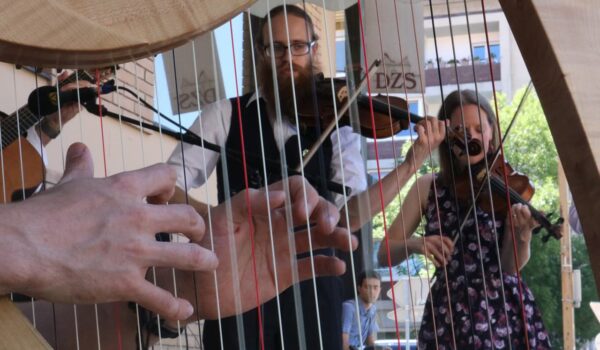
Nollaig Casey and Arty McGlynn are a most exciting duo
who together provide a rich mix of talent and experience. Nollaig and
Arty first met in Dublin in 1979, after which their musical paths crossed
again and again at recording sessions, television and radio studios and
on stage with Andy Irvine, Planxty, Makem & Clancy and Maura O'Connell.
The more they played together the more they enjoyed each other's company
and eventually in 1984 they married.
Having graduated from University College of Cork with a B-Mus degree at the early age of nineteen, she embarked upon a professional career, firstly with the RTE Symphony Orchestra where she remained for five years and later as a freelance player of growing stature. She joined the legendary band Planxty in 1980 and toured with them in Ireland, UK and Europe. In recent years Nollaig has recorded and toured with a variety of groups and musicians including, Moving Hearts, Liam O'Flynn, Mary Black and Elvis Costello. Her television appearances include the BBC TV series "Bringing it All Back Home" and "A River of Sound". Nollaig has also performed as a featured artist in Donal Lunny's Coolfin band with whom she has recorded and toured extensively. More recently She has performed as a soloist with the phenomenally successful 'Riverdance' as well as featuring in Shaun Davey's 'Granuaile' and 'May We Never Have To Say Goodbye' which was the theme song of the Special Olympic World Games 2003 which was hosted by Ireland.
The late sixties saw him move further afield, trips to UK and USA, moving from band to band and adding the pedal steel guitar to his musical arsenal along the way. But by the mid seventies the endless run of one nighters had begun to lose their appeal and Arty was beginning to look for something more real, something that would excite him again. Towards the end of the seventies, Arty revived his interest in Irish traditional music and his first solo album, "McGlynn's Fancy", was released in 1979 to great critical acclaim. This is the first recording ever in which the guitar is played in an authentic traditional style, and as such has been hailed as a classic in the traditional music world. Arty subsequently became one of the most sought after musicians in the country, playing and recording with the likes of Christy Moore, Paul Brady and Liam O'Flynn. He played as a member of such prestigious groups as Planxty, Patrick Street, De Danann and The Van Morrison Band. Arty subsequently became one of the most sought after musicians in the country, playing and recording with the likes of Christy Moore, Paul Brady, Donal Lunny and Liam O'Flynn. He played as a member of such prestigious groups as Planxty, Patrick Street, De Danann and the Van Morrison Band. Arty is equally in demand as a live performer, recording artist and producer. The album "Barking Mad" by the group Four Men & A Dog, which Arty produced, was voted Folk Album of the year by Folk Roots Magazine. He produced Christy Hennessy's album, "The Rehearsal", which remained in the Irish charts continuously for eighteen months, he also collaborated with Frances Black on her first two solo albums, "Talk to Me" and "The Sky Road", both of which have topped the charts in Ireland and have been critically received in the UK and America. In 1997 Arty suffered a severe setback when he broke his wrist while on tour in the USA, however a quick recovery has seen him back playing with all his immense skills, after only a few months. As well as performing live throughout Europe with Liam O'Flynn he also co-produced with Liam, Liam's most recent album The Piper's Call. Buy CD Online
"In the world of Irish traditional music, the guitar
may sometimes appear to have usurped the role of the bodhran as the instrument
of choice of those whose zeal exceeds their ability. Arty McGlynn plays
the guitar but there the similarity with other guitarists ends. Whether
performing solo, as a duo or as part of a larger group, he brings a unique
rhythmic and harmonic approach to the guitar, having developed a style
that has continually pushed at the accepted boundaries of whichever type
of music he happens to be performing. In the course of an extremely engrossing concert at An
Creagan centre, a capacity crowd which had braved the foggy winter night,
heard Arty and violinist Nollaig Casey play a program which went far beyond
the limits of most traditional fare. Nollaig is not in any sense the junior partner in this
duo. I resisted saying second fiddle. She is steeped in Irish music and
also has the advantage of being classically trained, which is clearly
audible in the impressive technique and tone she brings to her music.
Several pieces such as the piper's slow air 'Moran's Return' were unearthed
by her from manuscripts dating from 1844 and in the absence of her research,
might otherwise have remained unheard. In an even older piece 'The Clergy's
Lamentation' she demonstrated how to accentuate the beauty of the melody
by using only the very lightest vibrato, where less sensitive performers
would show considerably less restraint or taste. One of her own compositions
'Lios na Banriona', with its carefully controlled pace and ornamentation,
seems to hark back to an era when Irish music was not so far removed from
its Italian and French counterparts. Never one to move willingly into the spotlight, Arty shadowed
the violin throughout the performance, playing melodies in unison, adding
elegant harpsichord-like harmony or driving the music forward with a dropped
D tuning rhythm. When he imposes complex cross-rhythms over a fast moving
reel, the music is transformed and one begins to see how he can understand
and emulate the complicated metre and rhythmic patterns of the Bulgarian
and Galician music which were high points of the set. It is this sense on rhythm and harmony that has been his
essential contribution to the development of traditional music since the
late 1970's. Apart from some well intentioned attempts at adapting American
and English modal tunings to the solo performance of a few jigs and reels,
up to then no other guitarist could be said to have made any real musical
impression on the monolithic and extremely conservative traditional music
world. Arty's good humoured account of how he was eventually invited into
the inner sanctum need not obscure the fact the he basically invented
a role for the guitar and continues to dominate his field. He also proved
a useful translator, explaining to a mystified Nollaig that the title
of the Cork slow air 'Cape Clear' meant 'No Parking' in rural Tyrone. The audience was transfixed throughout this concert and
two encores were required before the night ended. A performance of this
calibre proves that Irish music in the hands of such gifted musicians
can develop and absorb international influences without any threat to
its own identity. Paul Maguire - Ulster Herald "Nollaig Casey and Arty McGlynn between them share
40 years playing experience at the cutting edge of what might be termed
modern Irish music. Both are exemplary musicians across a range of genres
which include classical, blues, rock and popular. All come together on
'Causeway', their finest collaboration to date. Both contribute instrumental
compositions, sometimes, not always emanating from the same musical source.
The title track - McGlynn's composition, a reel for our times - sports
a melody played on fiddle chasing a chugging funky engine of fender Telecaster,
drums and Hammond, which resolves into a masterfully constructed wall
of sound. 'Cabbage and Cale', also by McGlynn, is a subtle celebration
of the groove master whose accents are as green as the proverbial. 'Rainy
Summer is borne in on harmonica by Brendan Power, another musical multi-linguist,
sharing riff and counter-riff with fiddle, guitar and Hammond in an elegantly
jazzy invocation. 'Murals' is an hypnotic soundscape of Fender Telecaster,
harmonica and fiddle. Nuala O'Connor - The Irish Times "Casey produces a great range of sounds with her bow, from the silky sweet to the rough hewn, and her playing of slow airs suggests that - though the lyrics may be unsung - they must be in her mind as she plays, she does actually sing too. To say McGlynn provided accompaniment would be a crime of over-simplification. His fleet unison lines gave the jigs and reels huge momentum and his chordal patterns, full of bass lines come in an apparently infinite variety." Rob Adams - The Glasgow Herald "Guitarist Arty McGlynn shared an interesting personal memory with the packed audience at the Festival's Harp Club. for it was at the Harp Folk Club, as it was then known, that in 1978, as a comparatively unknown showband musician, he appeared as a guest of folk singer David Hammond. He stunned the crowd that night with the brillance of his guitar playing of traditional tunes and went on to become one of today's major figures on the Irish muisc scene. As he says 'It was a night which changed my life'. So it was as a main attraction that he now returned to the Harp Club with his wife, the fiddle player Nollaig Casey, to take us through a selection of tunes from their Causeway album. Their consummate musicianship, with McGlynn's articulate chords and single string runs accentuating his wife's graceful fiddle work in fast dance tunes and stately airs, was acknowledged rapturously by the audience." There's no substitute for class. Neil Johnston - Belfast Telegraph "It was clear from the opening bars of their set just why Casey and McGlynn attract so much interest. Casey's lyrical, singing fiddle, glanced and glided over and around McGlynn's richly imaginative harmonies, all expressed with an understanding which at times seemed almost the product of a single mind."Kenny Mathieson - The Scotsman "Causeway is a completely progressive album. While
the songs are dealt with in an orthodox way the tunes are much less traditional.
The driving force for this style seems to come from McGlynn himself who
brings his complete knowledge of jazz and blues to bear on Irish music. Lloyd Gorman - Irish Music
"Reflecting the disparate backgrounds of these
two exceptionally able players, Causeway is evenly divided between up-tempo
instrumental pieces with a full rock backing and more conventional, traditionally
arranged tunes and songs. Colm O'Hare - Hotpress
|
||||||||||